If you’ve ever spent time researching night vision or long-range observation gear, you’ve probably run up against two terms that feel interchangeable at first: thermal goggles and thermal scopes. As a thermal goggles supplier who’s worked with hunters, outdoor guides, tactical teams, and even hobbyists for the past seven years, I’ve heard that confusion firsthand. A customer will reach out and say, “I need a thermal scope for coyote hunting,” only to learn their actual need fits a pair of goggles far better—or vice versa. The line between the two isn’t just about naming conventions; it’s rooted in design, use case, performance, and what each gear is built to do. Today, I’m breaking down how these two tools stack up, so you don’t waste money on a piece of gear that doesn’t match what you need. Thermal Goggles

First, let’s get the basics straight: both thermal goggles and thermal scopes rely on thermal imaging technology, not the light amplification of older night vision gear. They detect the infrared (heat) radiation emitted by all objects above absolute zero, turning that invisible heat into a visible grayscale (or color) image. Warm things—like a deer’s body heat, a person’s boots, or even a campfire—show up bright, while cool backgrounds (trees, rocks, night sky) are darker. That core tech is the same, but every other part of the design is tailored to a specific job.
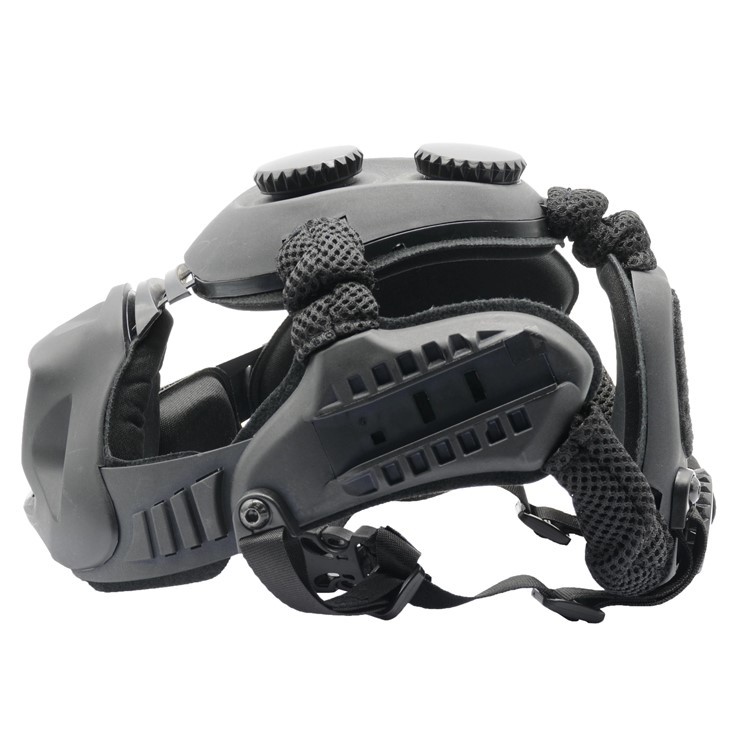
Let’s start with thermal goggles. If you’ve ever put on a pair of ski goggles or regular safety glasses, you’ll recognize the form factor: two eyepieces, each with its own small thermal sensor, connected by a head strap that sits over your eyes and forehead. The first thing that sets goggles apart is mobility. Unlike a scope, which mounts to a rifle or tripod and is fixed in place, goggles are hands-free (well, mostly hands-free—you can adjust the strap, but once they’re on, they don’t need to be held). That changes everything for how you use them. For a hunter tracking prey through dense woods at dawn, you don’t want to clamp a rifle to your shoulder, line up a reticle, and hold still for 10 minutes. Goggles let you scan the treeline with both eyes, walk over uneven ground, and react fast if you spot something moving. Tactical teams rely on this too: officers clearing a dark building can keep their hands on their firearm while scanning for threats, no need to mount a scope that would slow them down.
The sensors in thermal goggles are built for wide fields of view (FOV) too. Most high-quality goggles have a FOV of 40 to 50 degrees, compared to a typical thermal scope’s FOV of 8 to 15 degrees. That wide view is a game-changer for situational awareness. When you’re hiking and need to spot a lost hiker’s heat signature half a mile away, or a coyote darting through the underbrush off to your left, you don’t have to pan a scope back and forth to cover the area. Goggles let you take in your entire surroundings at once, which is why they’re the go-to for search and rescue teams, outdoor guides patrolling remote trails, and even birdwatchers looking for nocturnal species like owls. The downside here is that goggles don’t have the long-range magnification of a scope. Most goggles cap out at 2x to 4x magnification, while a good thermal scope can go from 6x all the way up to 20x for long-range shots. If your goal is to take a precise shot at a target a thousand yards out, a scope’s magnification is non-negotiable—but if you need to scan and react, goggles win.
Now, thermal scopes. These are the tools you’ll see mounted to hunting rifles, sniper rifles, and even some tactical vehicles. Their entire design is built for precision, fixed to a platform, and focused on long-range, targeted observation. Unlike goggles, scopes have a single eyepiece (though some larger models have two, for binocular-style scopes) and mount directly to a firearm via picatinny rails or similar brackets. That fixed mount means you can zero the scope once, and it stays accurate shot after shot—critical for anyone who needs to take a clean, precise shot at a distance. The magnification, as I mentioned, is another big differentiator. Thermal scopes are built with adjustable magnification, so you can zoom in on a heat signature at 1,500 yards, pick out details like an animal’s antlers or a person’s gear, and calculate range with built-in reticles. That’s not something goggles can do, because their wide FOV and hands-free design aren’t built for precision aiming.
Another key difference: weight and power. Thermal scopes are heavier than most goggles, because they need a sturdier housing to mount to a rifle, plus a larger sensor and higher-power battery to support long-range magnification and continuous use during long hunting trips or tactical missions. A heavy scope might be a non-issue if it’s fixed to a stable rifle, but if you’re walking for hours through rough terrain, the extra weight becomes a strain on your neck and shoulders. Goggles, by contrast, are lightweight—our top-selling thermal goggles weigh just 12 ounces, less than a full can of soda, so you can wear them for 8+ hours without fatigue. That’s a huge factor for backpackers, hunters on multi-day trips, or anyone who doesn’t want to carry extra weight.
Battery life is another practical point where the two diverge. Thermal goggles run on smaller, rechargeable lithium-ion batteries, and most models offer 10 to 12 hours of continuous use on a single charge. That’s more than enough for a full night of hunting, a day of trail patrol, or a multi-hour search and rescue mission. Thermal scopes, though, need more power to run their high-magnification sensors and reticle systems, so their batteries are larger. Even so, most scopes only get 4 to 6 hours of use on a single charge—something to keep in mind if you’re out for a long time without access to a charger.
Wait, but what about use cases where the line blurs? I’ve had customers tell me, “I want something that works for both hunting and hiking,” and that’s where it’s important to match the tool to the job. Let’s take coyote hunting, for example. Many coyote hunters start with a scope, because they want to take long-range shots at night. But if you’re hunting on public land with dense brush, you might need to scan a wide area before you spot a coyote, and goggles will let you do that far faster than a scope. Some hunters will use both: goggles to scan for movement, then switch to a scope to take the shot. That’s a smart hack, but it means carrying both pieces of gear, which isn’t always feasible.
Another blurry spot: binocular-style thermal goggles, which some people confuse with thermal scopes. These are goggles with two separate sensors, like regular binoculars, so you get a 3D image, and they often have 6x to 8x magnification. They’re a middle ground, but they’re still not the same as a scope, because they don’t mount to a rifle and lack the precision reticles needed for aiming. If you need that 3D depth perception, a binocular-style pair might work for casual long-range observation, but for hunting, a traditional scope is still the better pick.
Cost is another big factor for most buyers. At our company, our entry-level thermal goggles start at around $300, and our mid-range models (with 10-hour battery life, 4x magnification, and a 50-degree FOV) are around $800. Thermal scopes, though, start at $500 for a basic model, and high-end scopes with long-range magnification and high-resolution sensors can run $2,000 or more. The price gap comes down to the tech built for precision: scopes need sturdier mounting systems, higher-resolution sensors, and adjustable magnification that supports long-range aiming, all of which add up.
But here’s the thing I always tell customers: the “better” tool isn’t the one that costs more or has more features—it’s the one that does what you need it to do. If you’re a hunter who’s mostly taking shots within 500 yards, and you need to scan wide areas without fumbling with a rifle mount, thermal goggles are almost certainly the better choice. If you’re a long-range marksman who needs a fixed mount and 20x magnification to shoot at 1,500 yards, a scope is non-negotiable.
I’ve seen too many people drop $1,500 on a thermal scope because they thought it was “cool,” only to realize they can’t use it to scan for prey without mounting it to a rifle, and they end up carrying a heavy, underused piece of gear. Conversely, a customer who needed a hands-free pair for search and rescue might have bought goggles, but they later told me they wished they’d gotten a scope because they needed to zoom in on a distant heat signature to identify a hiker.
So, how to make the right choice? Let’s break it down into simple questions: First, are you going to mount this tool to a firearm? If yes, a scope is made for that purpose, and it’s built with the precision aiming features you need for shots. If no, go with goggles, because they’re hands-free, lightweight, and built for scanning wide areas. Second, what’s your typical distance? If you’re mostly observing or targeting things under 800 yards, goggles work great. If you’re regularly at 1,000 yards or more, the scope’s magnification will make a huge difference. Third, how long will you use it? If you’re out for 8+ hours at a time, goggles’ longer battery life and lighter weight will keep you from getting fatigued, while a scope’s heavier build and shorter battery might hold you back.
Now, I know some of you are wondering about resolution, too, because that’s a big part of image quality. Both goggles and scopes come in 320×240 and 640×480 pixel resolutions. A higher resolution means a crisper image, especially at long distances. The 640×480 models are more expensive, but they’re worth it if you need to pick out small details, like an animal’s face or a person’s gear at distance. Here, again, scopes have an edge: a 640×480 sensor in a scope will give you a clearer zoomed-in image than the same sensor in goggles, because the scope’s optics are optimized for magnification. That’s why long-range hunters often pay more for a scope with a higher resolution, while casual hikers might get away with a 320×240 goggle pair.
I also get asked about color vs. grayscale. Both tools offer color palettes—some people like “white hot” where warm objects show up bright white, “black hot” where they’re black, and colormodes like red or iron for easier spotting in certain light. There’s no performance difference here; it’s just personal preference. Both goggles and scopes have the same color mode options, so that doesn’t factor into the comparison between the two.
Another practical detail: water resistance. Most goggles and scopes are rated IP67 or IP65, meaning they can handle rain, snow, and being dropped in shallow water. But goggles are often more compact, so they’re easier to stow in a backpack, while scopes need a bigger case to protect the mounting hardware and lens. If you’re backpacking through wet conditions, goggles’ compact size might be a plus, but both are durable enough for most outdoor use cases.
At the end of the day, the biggest mistake buyers make is treating thermal goggles and thermal scopes as interchangeable. They’re two separate tools, each designed for a specific job. Goggles are for mobility, situational awareness, and hands-free use. Scopes are for precision, long-range shooting, and mounting to a platform. Neither is better than the other—they just fit different needs.
If you’re still not sure which one is right for you, I’d be happy to help. I’ve worked with hunters, tactical teams, and outdoor enthusiasts for years, and I can walk you through the specs, use cases, and budget options that fit what you’re looking for. Don’t waste money on a tool that doesn’t match your needs—reach out to us to discuss your requirements, and I’ll help you find the right thermal gear for your next trip, hunt, or mission.
Thermal Binocualars References:
- Thermal Imaging Technology: Principles and Applications, SPIE Press, 2021
- "Night Vision and Thermal Imaging: A User’s Guide", Outdoor Industry Association, 2022
- Thermal Goggle vs. Scope: Comparative Analysis, Tactical Gear Journal, Vol. 15, No. 3, 2023
- Battery Life and Weight Considerations for Portable Thermal Devices, Journal of Outdoor Recreation and Technology, 2022
- "Long-Range Thermal Observation: Scopes vs. Binocular Goggles", Hunter’s Weekly, 2023
Shenzhen Detyl Optoelectronics Co., Ltd.
With abundant experience, we are one of the most professional thermal goggles manufacturers and suppliers in China. Please rest assured to buy customized thermal goggles at competitive price from our factory. For pricelist and quotation, contact us now.
Address: 4th Floor, Building 3, Factory, No. 20, Second Industrial Avenue, Tangxiayong Community, Yanluo Street, Bao’an District, Shenzhen
E-mail: sales@detyl.com
WebSite: https://www.detyl.net/
